Wilderness Edge

Visitor guide

Whiteshell Provincial Park

2,721 square kilometres of granite, pine and water in southeast Manitoba, holding more than 200 lakes. Here is what is in it and how to reach it.

Made a park
1961
Size
About 2,720 km²
Lakes
More than 200
To Falcon Lake
126 km east

What the Whiteshell is

The Whiteshell is Manitoba's best known park. It sits in the southeast corner of the province and runs to the Ontario border. It was a forest reserve from 1931 and became a provincial park in 1961.

It is all Canadian Shield. Bare pink granite, black and white spruce, jack pine, balsam fir and aspen, and water everywhere. A dozen rivers run through it and more than 200 lakes sit in the rock. The Whiteshell River strings West Hawk Lake, Caddy Lake, Jessica Lake, White Lake and Betula Lake together before it joins the Winnipeg River.

People come to swim, paddle, fish, hike and sit by a fire. In winter they come to ski, snowmobile and fish through the ice. Falcon Lake is 126 km east of Winnipeg on the Trans-Canada, which most people drive in about 90 minutes.

Where the name comes from

The park is named after the megis: a small white seashell that is sacred to the Anishinaabe. The teaching is that the Creator used it to breathe life into people.

People have lived here for at least 8,000 years. The petroforms were laid out by Algonkian speaking peoples, ancestors of today's Anishinaabe, and the Midewiwin society used them for healing. Around 1800 more Anishinaabe moved into the area from the Lake Superior country.

The first Europeans came through in the spring of 1733, when the La Vérendrye expedition found a Cree settlement using sturgeon weirs on the river. After that the Winnipeg River became a main fur trade route. Alexander Mackenzie, David Thompson and the painter Paul Kane all travelled it. The brigades ran until the North West Company merged with the Hudson's Bay Company in 1821.

The railway arrived next. CPR construction started in 1877 and trains were running between Winnipeg and Fort William by 1883. Rennie began as a stop where locomotives took on coal and water. The first summer cottages went up around 1920 near Brereton Lake and the West Hawk and Falcon Lake shores, and people have been coming out for the weekend ever since.

The lakes

Six you should know by name. Each one has its own campground, its own beach, and its own crowd of people who swear it is the best one.

South Whiteshell · off the Trans-Canada

West Hawk Lake

The deepest lake in Manitoba at 115 metres, and 16.2 square kilometres across. The round shape is a crater. A meteor hit the granite here and the lake filled the hole. Divers come for the clear water.

South Whiteshell · off the Trans-Canada

Falcon Lake

The busiest lake in the park, with five islands, a golf course, a beach and a strip of shops. Named after Pierre Falcon, the Métis songwriter who lived from 1793 to 1876.

South Whiteshell · near West Hawk

Caddy Lake

Famous for the tunnels. Two granite tunnels were blasted under the rail line and now let you paddle straight through the rock into South Cross Lake, then on to North Cross Lake. The first one is about a 2.5 km paddle from the resort docks.

North Whiteshell · on PR 307

Nutimik Lake

A wide spot on the Winnipeg River with a large campground and a store. The Bannock Point petroforms are about 6 km east of it along the same road.

North Whiteshell · on PR 307

Betula Lake

Sits between White Lake and Nutimik Lake, with a campground and a sand beach. Quieter than the southern lakes and a good base for the petroforms.

North Whiteshell · off PTH 44

Brereton Lake

One of the northern campgrounds, along with Otter Falls, White Lake and Big Whiteshell Lake. Good fishing, and close to the Alfred Hole Goose Sanctuary at Rennie.

Bannock Point petroforms

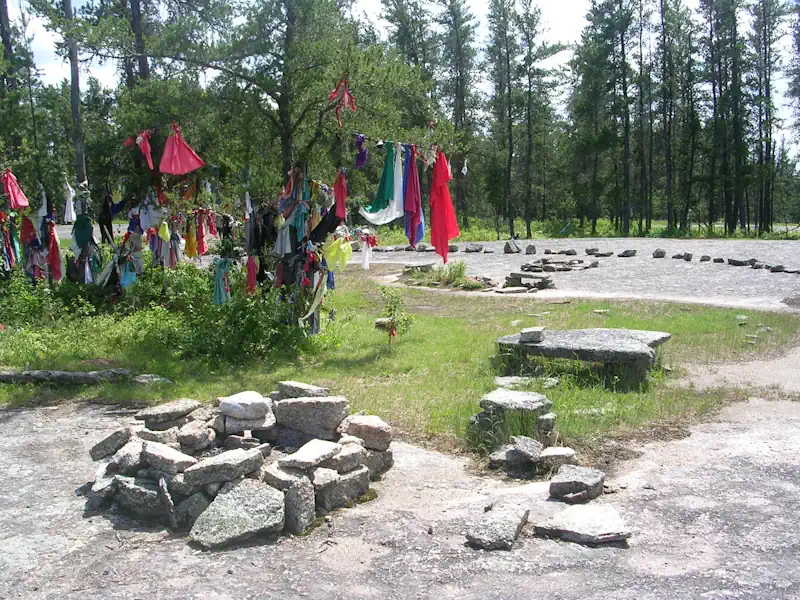
Bannock Point is a flat sheet of bedrock with stones laid out on it in the shape of snakes, turtles, fish, people and a thunderbird. First Nations people placed them here for teaching and for ceremony. Some are thought to be up to 2,000 years old. The site is still sacred and still used.

You can visit. Bannock Point is on Provincial Road 307, about 6 km east of Nutimik Lake. Manitoba park interpreters run free guided walks through the summer and will take a group or a class by arrangement. Call the Park Interpreter's office at 204-369-3157.

The larger site at Tie Creek is closed to visitors. It holds the biggest collection of petroforms in North America, and in 1979 the province fenced off nine acres of it to keep it undisturbed. That fence is still there.

Stones laid out on bedrock at Bannock Point
Bannock Point, off Provincial Road 307. Walk the marked path and leave every stone where it lies.

Trails worth the drive

The Mantario Trail is the big one. 64 km of granite ridge, bog and lake between Caddy Lake and Big Whiteshell Lake. Most people take three to five days. It is remote, it is hard, and help can be hours or days away, so it is for experienced backpackers carrying everything they need.

Hunt Lake Trail is the hard day hike. 13 km along the shore of West Hawk Lake, over bare granite, with roots and rock the whole way. Take water and good boots.

Falcon Creek Trail is 2.2 km and easy. It is also where a man reported being burned by a landed craft in 1967, in what is still called the Falcon Lake incident. Park interpreters run a guided hike and tell the story.

The short self guiding trailsare the best of the park for an hour of your time: Amisk, Pine Point, McGillivray Falls, Forester's Footsteps and the Whiteshell River trail. Signs along each one explain what you are looking at.

The Trans Canada Trail runs along the western side, and the section from Pinawa to the Seven Sisters dam is about 17 km of easy walking, riding or skiing.
Places to stop with a roof

Four small museums and centres, and all of them are worth a rainy afternoon.

  • Alfred Hole Goose Sanctuary at Rennie. Canada geese nest here each spring and there is an observation gallery over the lake.
  • Whiteshell Fish Hatchery Interpretive Centre. Where the walleye you are trying to catch start out.
  • West Hawk Museum. The story of the crater, told where it happened.
  • Whiteshell Natural History Museum. Rock, plants and animals of the park in one room.

How to get in

From the south

Trans-Canada Highway 1

The fastest way to Falcon Lake and West Hawk Lake. About 90 minutes from Winnipeg, and you stay on divided highway nearly the whole way.

From the north

Provincial Road 307

Enters the park at Seven Sisters Falls and runs along the Winnipeg River past Nutimik, Betula and White Lake. This is the road to Bannock Point.

From the middle

Provincial Trunk Highway 44

Comes in at Rennie, near the goose sanctuary, and links the northern lakes to the southern ones through the middle of the park.

Where to stay

Inside the park you have campgrounds, cabins and a handful of resorts. There are eleven park campgrounds: Betula Lake, Big Whiteshell Lake, Brereton Lake, Caddy Lake, Falcon Lake Beach, Falcon Lake Lakeshore, Nutimik Lake, Opapiskaw, Otter Falls, West Hawk Lake and White Lake. Book early for July and August.

Wilderness Edge is not in the park. We are in Pinawa, on the western edge of it, about ten minutes from the boundary and a short drive from the north gate at Seven Sisters Falls.

That matters if you are bringing a group. Campgrounds are built for families of four. We have 143 guest rooms, a kitchen that feeds hundreds at a sitting, meeting rooms with heat and power, and everyone under one roof. Groups use us as the base and drive into the park for the day.

Common questions

Planning a group trip to the Whiteshell?

Send us your dates and headcount. We come back the same day with rooms, meals and activities priced in one quote.

© 2026 Wilderness Edge ltd. All Right Reserved. Privacy Policy Terms of Service

Technology partner with

everybooking.com

Free 2 Night Stay w/ Meals

For group organizer and plus 1
Some minimums apply

$0
00
No taxes
Start here

Groupoffer2026
